
Holy War
2026
Kickoff at Rice-Eccles Stadium in…
Your independent guide to the best live sports in Salt Lake City! This website is operated by a ticket broker.
Ticket prices are set by third-party sellers and may be above or below face value.
We are not affiliated with nor endorsed by the BYU Cougars or the Utah Utes.
Holy War 2026: BYU Seeks Fourth Straight Win in Salt Lake City
The Holy War returns to Rice-Eccles Stadium on Saturday, November 7, 2026, as the BYU Cougars travel to Salt Lake City looking to extend their winning streak to four games against the Utah Utes. The Big 12 Conference released its 2026 schedule on January 21, confirming this marquee rivalry matchup as one of the most anticipated games of the season.
BYU enters the 2026 Holy War riding an impressive three-game winning streak against Utah—their longest in the rivalry since winning four consecutive meetings from 1989 to 1992. Meanwhile, Utah will play its first Holy War under new head coach Morgan Scalley, who took over after legendary coach Kyle Whittingham retired following 21 seasons at the helm.
2025 Holy War Recap: BYU 24, Utah 21
The 2025 Holy War lived up to its billing as one of the most dramatic installments in recent memory. On October 18, 2025, #15 BYU hosted #23 Utah at LaVell Edwards Stadium in a nationally televised prime-time showdown on FOX. True freshman quarterback Bear Bachmeier delivered a performance for the ages, racking up 229 total yards while leading two fourth-quarter touchdown drives to overcome a 14-10 deficit.
Bachmeier’s defining moment came with under five minutes remaining—a 22-yard touchdown scramble where he dragged multiple Utah defenders into the end zone, prompting FOX announcer Jason Benetti to exclaim, “There’s a Bear on the loose in Provo!” The Cougars held on 24-21, with safety Tanner Wall sealing the victory with a crucial interception.
BYU went on to finish 11-2 and reach the Big 12 Championship Game, where they fell to Texas Tech 34-7. Utah finished 8-4, and in December 2025, Whittingham announced his retirement after building Utah into a national power.
Why It’s Called the “Holy War”
The rivalry’s distinctive name stems from the religious undertones that set it apart from other college football matchups. Brigham Young University is owned and operated by The Church of Jesus Christ of Latter-day Saints, with approximately 98% of its student body being church members. The University of Utah, while a secular public institution with a substantial LDS population, represents a more religiously and culturally diverse community.
The term “Holy War” gained widespread use in the 1990s through local sports radio, though it was occasionally applied earlier to BYU’s matchups against Notre Dame. The nickname became nationally recognized from 2003 to 2008, when the Holy War winner frequently captured the Mountain West Conference championship.
A New Era: Big 12 Conference Rivalry
Since BYU joined the Big 12 in 2023 and Utah followed in 2024, the Holy War has carried conference championship implications for the first time since 2010. The Big 12 designated this matchup as a “protected” annual rivalry, guaranteeing the Cougars and Utes will face each other every year through at least 2027.
The 2026 Holy War will be played on November 7—notably not during rivalry weekend at the end of the season. This marks the third consecutive year the Big 12 has scheduled the game in the middle of the conference slate rather than as a season finale, a decision that has drawn mixed reactions from both fan bases.
Complete Guide to Holy War 2026
Rice-Eccles Stadium: Utah’s Fortress
Rice-Eccles Stadium in Salt Lake City hosts Utah home games and will be the site of Holy War 2026. Built in 1998 and expanded multiple times since, the venue gained international recognition as the host of the Opening and Closing Ceremonies of the 2002 Winter Olympics. The stadium features a FieldTurf playing surface at 4,637 feet elevation with a current capacity exceeding 51,000 following the Ken Garff Red Zone expansion completed in 2021.
The stadium’s setting is spectacular—the Wasatch Mountains rise dramatically to the east while views of downtown Salt Lake City, the Great Salt Lake, and the Oquirrh Mountains spread to the west. Utah fans have supported 60+ consecutive sellouts, creating the “MUSS” (Mighty Utah Student Section) atmosphere that makes Rice-Eccles one of the toughest road environments in college football. BYU has not won at Rice-Eccles since 2006, adding extra intrigue to the 2026 matchup.
LaVell Edwards Stadium: BYU’s Home
While the 2026 Holy War is in Salt Lake City, the rivalry will return to LaVell Edwards Stadium in Provo in 2027. Named for legendary coach LaVell Edwards, the venue opened in 1964 and seats 62,073—the largest capacity in the Big 12 Conference. The stadium underwent significant renovations in 2024, including new LED lighting and enhanced player facilities. BYU’s passionate student section, “The ROC” (Roar of Cougars), creates one of college football’s most intimidating home environments.
The Coaches: New Blood vs. Established Success
Morgan Scalley – Utah
Morgan Scalley takes over the Utah program after serving as defensive coordinator under Whittingham for over a decade. The former Utah safety (2001-2004) was named head-coach-in-waiting in 2019 and inherits a program that has won 10+ games in five of the last seven seasons. Scalley’s 2026 squad returns several key players from an 8-4 campaign, including experienced pieces on both sides of the ball. His first Holy War as head coach carries immense pressure—Utah fans are eager to snap BYU’s winning streak.
Kalani Sitake – BYU
Kalani Sitake has transformed BYU football since taking over in 2016. The former BYU fullback led the Cougars to an 11-1 record in 2020, consecutive 11-win seasons in 2024-25, and the program’s first Big 12 Championship Game appearance in 2025. Under Sitake, BYU has won three straight Holy Wars and established itself as a consistent contender in the Big 12. Entering 2026, the Cougars boast one of the nation’s most talented rosters, led by sophomore QB Bear Bachmeier.
Recent Holy War Results
- 2025: BYU 24, Utah 21 (Provo) – Bear Bachmeier’s 22-yard TD run seals it
- 2024: BYU 22, Utah 21 (Salt Lake City) – Cougars overcome halftime deficit
- 2023: BYU 35, Utah 27 (Provo) – First Big 12 meeting, BYU ends 9-game skid
- 2009-2022: Utah won 9 of 10 meetings during BYU’s independent era
All-Time Series Highlights
The Holy War dates back to 1896, making it one of college football’s oldest rivalries. Utah leads the all-time series, though momentum has shifted dramatically to BYU in recent years. Memorable moments include:
- 1993: John Walsh’s miracle pass to Chris Smith gave BYU a 34-31 victory
- 1998: Utah crushed BYU 40-3 in their first game at Rice-Eccles Stadium
- 2008: Utah’s dominant 48-24 victory en route to an undefeated season and Sugar Bowl berth
- 2021: Utah’s 38-24 win capped their run to the Pac-12 Championship
- 2025: Bear Bachmeier’s legendary scramble lifts BYU to third straight win
Notable Holy War Players
The rivalry has featured numerous NFL players and college football legends:
BYU: Steve Young, Ty Detmer (Heisman Trophy winner), Jim McMahon, Taysom Hill, Zach Wilson, Bear Bachmeier
Utah: Alex Smith, Eric Weddle, Star Lotulelei, Britain Covey, Cam Rising, Devon Dampier
How to Get Holy War 2026 Tickets
- Mark your calendar: The Holy War is confirmed for Saturday, November 7, 2026 at Rice-Eccles Stadium in Salt Lake City.
- Explore official channels: Utah’s athletic department will release tickets through UtahUtes.com and the Utah Athletics Ticket Office.
- Consider the resale market: Holy War tickets sell out quickly. Verified resale marketplaces offer authentic tickets with buyer protection when official channels are unavailable.
- Plan your travel: Salt Lake City offers numerous hotel and dining options. Book accommodations early—rivalry weekend fills hotels throughout the valley.
- Know the venue rules: Rice-Eccles Stadium permits clear bags and small clutch purses. Review official policies before arriving.
Why Buy From a Verified Resale Marketplace?
Holy War tickets routinely sell out through official channels, especially for high-stakes matchups like the 2026 game. Our trusted ticket marketplace connects fans with verified sellers offering authentic tickets. With over 20 years in business and the highest ratings on Trustpilot, we provide upfront all-in pricing (no hidden fees), buyer protection on every purchase, and secure transaction processing.
Game Day Tips
Getting There: Rice-Eccles Stadium is located at 451 South 1400 East in Salt Lake City on the University of Utah campus. The stadium is accessible from I-15 and I-80. Utah Transit Authority (UTA) provides game day transportation, including TRAX light rail with a station near campus.
Tailgating: Utah’s Rice-Eccles Stadium allows traditional tailgating in designated lots. Arrive early to secure parking and enjoy the pregame atmosphere.
Weather: November games in Salt Lake City can be cold. Average high temperatures in early November hover around 52°F (11°C), with lows near 34°F (1°C). Dress in layers and prepare for potentially frigid night-game conditions.
Frequently Asked Questions: Holy War 2026
When is the Holy War 2026?
The Holy War 2026 is scheduled for Saturday, November 7, 2026. This was confirmed when the Big 12 Conference released its 2026 football schedule on January 21, 2026. Kickoff time will be announced closer to the game.
Where is the Holy War 2026 being played?
The 2026 Holy War will be played at Rice-Eccles Stadium in Salt Lake City, Utah. This is a Utah home game, meaning the Utes will host BYU. The venue holds over 51,000 fans and has been extremely difficult for BYU—the Cougars haven’t won in Salt Lake City since 2006.
Who won the 2025 Holy War?
BYU won 24-21 in Provo on October 18, 2025. True freshman QB Bear Bachmeier had 229 total yards and scored the go-ahead touchdown on a memorable 22-yard scramble. This gave BYU its third consecutive victory in the rivalry.
What is BYU’s current winning streak in the Holy War?
BYU has won three straight Holy War games (2023, 2024, 2025). This is their longest winning streak in the rivalry since they won four consecutive meetings from 1989 to 1992. A 2026 win would tie that streak.
Who is Utah’s new head coach?
Morgan Scalley is Utah’s new head coach, taking over after Kyle Whittingham retired in December 2025 following 21 seasons. Scalley served as Utah’s defensive coordinator and was the designated head-coach-in-waiting since 2019. The 2026 Holy War will be his first as head coach.
Why is it called the Holy War?
The rivalry earned its name due to the religious dynamic between the schools. BYU is owned by The Church of Jesus Christ of Latter-day Saints with an approximately 98% LDS student body, while Utah is a secular public university with a more diverse population. The term became popular through local sports media in the 1990s.
What conference are BYU and Utah in?
Both teams are members of the Big 12 Conference. BYU joined in 2023 and Utah followed in 2024. The Holy War is now a conference game with direct implications for Big 12 standings and potentially the College Football Playoff. It’s designated as a protected annual rivalry through at least 2027.
Who leads the all-time Holy War series?
Utah leads the all-time series, though the margin has narrowed with BYU’s three straight wins. Utah dominated from 2009-2022, winning nine of ten meetings, but BYU has reclaimed momentum since both teams joined the Big 12.
How much do Holy War tickets cost?
Face-value tickets typically range from around $50 for upper-level seats to $150+ for premium sideline locations. However, Holy War tickets are high-demand—resale prices often exceed face value, particularly for close games with conference implications like 2026.
Will the Holy War 2026 be on TV?
Yes. As a Big 12 Conference game, the Holy War will air nationally on either FOX, ESPN, or TNT Sports (Big 12’s broadcast partners). The 2025 Holy War drew over 2 million viewers on FOX. Exact broadcast details will be announced approximately 12 days before kickoff.
How far apart are Provo and Salt Lake City?
Approximately 45 miles via Interstate 15, typically a 45-60 minute drive depending on traffic. BYU fans traveling to the 2026 Holy War should expect heavy traffic around Rice-Eccles Stadium on game day.
Is tailgating allowed at Rice-Eccles Stadium?
Yes. Utah allows traditional tailgating in designated parking lots around Rice-Eccles Stadium. Arrive early to secure a spot—lots fill quickly for rivalry games. Review Utah Athletics’ tailgating policies for specific rules on grills, tents, and setup times.
What should I wear to the Holy War?
Fans wear team colors: royal blue and white for BYU, red and white for Utah. November games in Salt Lake City can be cold, so layering is essential. Prepare for temperatures potentially dropping into the 30s by kickoff.
Is this an official BYU or Utah website?
No. This is an independent ticket marketplace operated by a licensed ticket broker. We are not affiliated with, endorsed by, or connected to BYU, Utah, the Big 12 Conference, or any athletic department. For official information, visit BYUCougars.com or UtahUtes.com.
When was BYU’s last win at Rice-Eccles Stadium?
BYU last won at Rice-Eccles Stadium in 2006. Utah has dominated the rivalry at home since then, making the 2026 matchup a significant opportunity for the Cougars to break through on the road.
Rice Eccles Stadium Seating Chart for Holy War
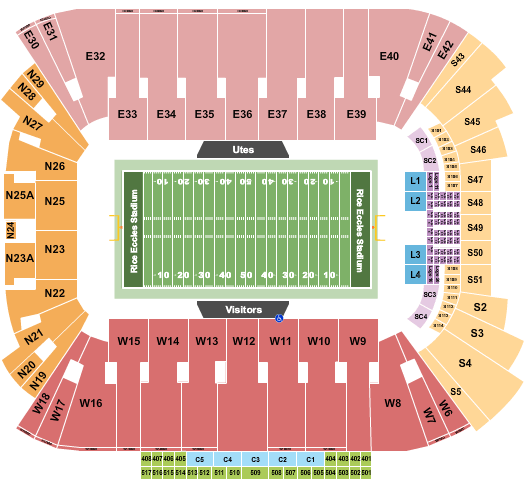
Rice Eccles Stadium Upcoming Events
Follow your to Rice Eccles Stadium
See Holy War live at Rice Eccles Stadium!
- 451 South 1400 East
Salt Lake City, Utah 84112